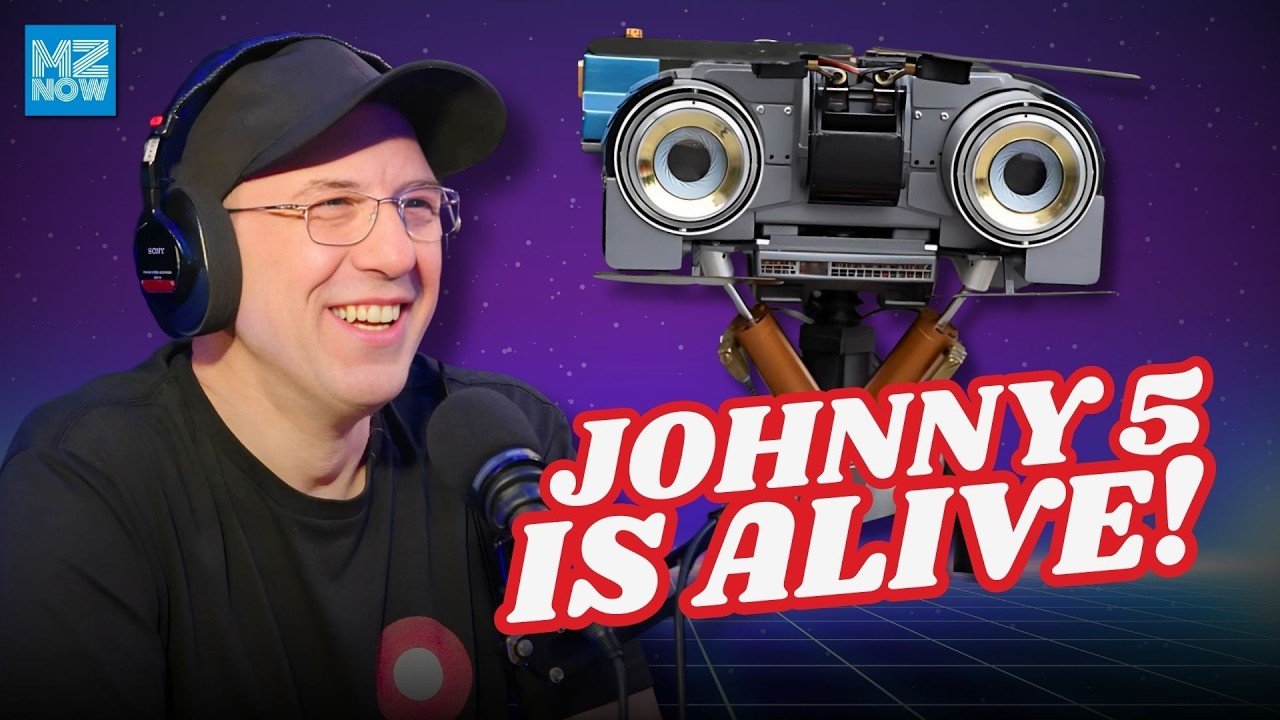
Number 5 is alive, and he lives in Dallas–Fort Worth.
Sean, the builder behind Texas Johnny 5 Build, has spent the better part of a decade turning the robot from Short Circuit into a full-size, one-to-one replica that actually works. He rolls on his tracks, his eyebrows move, he talks back, and he can rise up on his tiptoes just like he did on screen in 1986. When Sean brought him by MZNOW, Michael asked the question every fan wants answered: what does something like this actually cost?
01The $40,000 answer
Sean doesn’t usually give a number. For us, he did. “You’re going to spend upwards of, just parts alone to build a full size, 30, 40,000 easily,” he said. That figure doesn’t include his time, which he puts at three or four years of straight labor on nights and weekends. If you paid someone else to build one, he said, you could easily double it. Michael, who had been guessing something closer to $5,000, took that news about as well as you’d expect.
02Where the money goes
The money adds up fast because almost nothing on Johnny comes off a shelf. Take a single eye. The two servos that move it run about $40 each, and the custom circuit boards behind it cost around $100 for the set. The lens itself is a vintage camera lens that has to be found and then machined to match the movie. Sean bought his pair years ago for about $75. Today, he said, you’d pay “maybe a couple hundred or more, if you can even find it.”
Not every part is that painful. The 3D-printed pieces are the bargain of the build. “If you own a printer, it’s $25 a roll, and this is a fraction of a roll,” Sean said. But you can’t print the whole robot and expect it to move. There is a fully printed Johnny 5 out there, but it’s built for display, because a working one needs real metal where it carries weight. “The way he’s awkward in how he stands, he would just crumble under his own weight.” Sean’s build mixes resin and filament prints with aluminum, steel and stainless steel, some machined by specialists and some made in his own garage. He taught himself 3D printing and how to run a lathe for this project, bought spare parts from other builders, joined group part runs to bring costs down, and gets laser-cut pieces from his sponsor, SendCutSend. A single arm, with working fingers and a stack of servos, took him about two weeks of three-to-four-hour nights plus full Saturdays and Sundays.
All of that work rests on a fan community called Input Ink, whose members spent about 20 years documenting a screen-used robot piece by piece, measuring every part like a crime scene, and turning it into plans a builder could follow. Sean says it’s only in the last few years that the plans got complete enough to build a working one. For perspective, the studio built 10 to 15 robots for the original film in about three or four months, spent millions doing it, and needed a team of puppeteers to bring each one to life.
03368 pounds of classic car
Then there’s the weight. For years Sean guessed Johnny came in around 400 pounds, going off the CAD drawings, because no scale he could find was big enough. When he finally weighed him before shipping him to Astoria, Oregon, for the Short Circuit 40th anniversary, the real number was 368 pounds. Packed in his crate with tools and spare parts, the whole load hit 900. Around town, Johnny rides in a rented U-Haul trailer, and he has a kill switch on its own separate fob just in case. “At 400 pounds, I could hurt somebody,” Sean said. “He rolled off onto my foot one day and I thought I was going to lose my toe.”
Even insuring him is unusual. A normal collector’s policy needs something to compare against, and there’s nothing to compare Johnny to. So Sean keeps a spreadsheet of every single part, and the robot is insured at an agreed value based on that list.
People offer to buy him all the time, and Sean has a stock answer: “You can buy it, but you won’t be able to maintain it.” He compares it to owning a classic car. There is always something to fix, and he proved it in Astoria, where one of the gearboxes in Johnny’s tracks shredded on the deck of the actual Short Circuit house, in front of a crowd. He swapped in spares, and the second gearbox blew later that same night. The batch turned out to be defective. It’s also why appearances aren’t free, even when an event offers to cover travel. “It’s not just me getting there,” he said. “It’s the fact that I’m going to run him for eight hours and something is going to likely let go.”
04Giving him a voice
What people remember, though, is the talking. Sean’s Johnny runs on ChatGPT with an ElevenLabs voice cloned from Tim Blaney, the actor who voiced Johnny 5 in the films. Blaney is a fan of the build, and in Astoria he spoke live through Sean’s robot, the mouth lights moving with his voice, probably for the first time since Short Circuit 2. Sean also keeps a running bio for Johnny that he updates after every event, so the robot knows where he’s been and who he’s met. Kids freak out when he says their name. The internet did too: Sean’s first real TikTok, cut to a Six Million Dollar Man style intro, hit 1.8 million views.
Sean isn’t building a second Johnny anytime soon. Instead he’s making swap-out accessories, starting with the punk look from Short Circuit 2, and each new head costs several thousand dollars in parts. After that, he wants to build a WALL-E, which, as he points out, does not weigh 400 pounds and fits in an SUV.
You can follow the build at Texas Johnny 5 Build (TJ5 Build) on TikTok, Instagram, Facebook and YouTube. And you can watch Sean’s visits to MZNOW here: He Built a REAL Johnny 5 Robot in His Garage, Breaking Down the Cost of a Johnny 5 Eye, and Johnny 5 Goes to Oregon: The Short Circuit 40th Anniversary Recap.